
India's industrial production growth rose to a 14-month high of 10.3 per cent in August, mainly due to good show by the manufacturing, mining and power sectors, according to the official data released on Thursday. The factory output growth measured in terms of the Index of Industrial Production (IIP) had contracted by 0.7 per cent in August 2022. The previous high was recorded at 12.6 per cent growth in June 2022.

The IIP growth was 0.6 per cent as against 1.7 per cent in April last year.

India's industrial production growth accelerated to a 4-month high of 3.5 per cent in July this year due to good performance of manufacturing sector, according to official data released on Thursday. The country's industrial output earlier recorded this level of growth at 3.9 per cent in March 2025.

Wipro reported Q4FY26 IT services revenue of $2.6 billion, a modest 0.2 per cent Q-o-Q constant currency growth, with adjusted operating profit margin beating estimates at 17.2 per cent. The company announced a significant share buyback of ~15,000 crore, but faces near-term growth challenges, particularly in the BFSI segment, and has issued a soft Q1FY27 revenue guidance.

India's industrial production growth decelerated to a four-month low of 2.4 per cent in July, mainly due to poor showing by manufacturing, power and mining sectors, according to official data released on Monday. The data showed that the previous low in industrial output growth was recorded at 2.2 per cent in March this year. IIP grew 6.7 per cent in April, 19.6 per cent in May and 12.7 per cent in June.

India's industrial production growth slipped to five-month low of 1.1 per cent in March from 5.8 per cent in February 2023, mainly due to poor performance of power and manufacturing sectors, according to official data released on Friday. The previous lowest level of growth was recorded in October 2022 at a contraction of 4.1 per cent. The factory output growth measured in terms of the Index of Industrial Production (IIP) stood at 2.2 per cent in March 2022.

The first economic readings to be published in 2015 will be out on Monday, when the government releases industrial output data for November and the consumer price index for December.

The Index of Industrial Production (IIP) grew by 1.4 per cent in November as most components like manufacturing, electricity, mining, primary goods, and consumer durables witnessed a slowdown, according to data released by the National Statistical Office (NSO) on Wednesday. This is on the base of a decline of 1.7 per cent in November 2020 and before the new Covid variant started impacting economic activity. IIP growth was lower than the 4 per cent expansion recorded in the previous month but was better than a 1.6 per cent contraction seen in November 2020. Separately, rising prices of kitchen staples pushed retail inflation, or rate of price increase, to 5.59 per cent in December 2021, bringing it close to the upper band of Reserve Bank's comfort zone.

Base revisions are technical exercises, but history shows they can significantly reshape the narrative around India's growth performance.

India's eight key infrastructure sectors grew at a slower pace of 1.8 per cent in November against 5.8 per cent in the same month last year, amid a dip in production of crude oil, natural gas, refinery products, and electricity, according to official data released on Monday.

Stock markets will be driven by RBI's interest rate decision, tariff-related developments, global trends and trading activity of foreign investors in this holiday-shortened week, analysts said.

India's industrial production growth slowed to 2.7 per cent in April 2025 due to poor performance of manufacturing, mining and power sectors, according to official data released on Wednesday.

India's wholesale price inflation (WPI) increased for the fourth consecutive month in February, reaching 2.13 per cent, primarily due to rising prices of food and manufactured goods, according to government data.
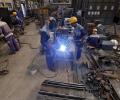
IIP down due to poor show by manufacturing, mining and power sectors

Industrial production growth slowed down to five-month low of 0.4 per cent in August mainly due contraction in manufacturing output and lower offtake of consumer goods.
India's industrial production growth slowed to a nine-month low of 1.2 per cent in May 2025 due to poor performance of manufacturing, mining and power sectors caused by the early onset of monsoon, according to official data released on mMonday. The factory output, measured in terms of the Index of Industrial Production (IIP), had expanded by 6.3 per cent in May 2024.

Capital goods output rose by a robust 20 per cent in the month under review as against a contraction of 2.4 per cent earlier.

The November IIP has been revised upwards to 3.9% from 3.8%.

Wholesale price inflation extended upward momentum for the third straight month, at 1.81 per cent in January, driven by an uptick in prices of food, non-food articles, and manufactured items on a month-on-month basis, government data showed on Monday.

India's eight key infrastructure sectors' output stood at 3 per cent in September, slower than the 6.5 per cent expansion recorded in August, according to official data released on Tuesday. The core sectors' output growth was 2.4 per cent in September last year.

Industrial production contracted by 1.9 per cent in November, entering the negative territory after a two-month gap, mainly due to poor showing by manufacturing and mining sectors, official data showed on Tuesday. The manufacturing sector -- which constitutes 77.63 per cent of the index of industrial production (IIP) -- recorded a contraction of 1.7 per cent in November 2020, as per data released by the National Statistical Office (NSO). Mining sector output too witnessed a decline, shrinking 7.3 per cent.

India's new national accounts will leverage new data sources and surveys to enhance the measurement of the country's informal economy, and introduce double deflation methods across sectors, replacing the current system that relies on a single deflation mechanism in Gross Domestic Product (GDP) calculations.

After a record-breaking year, India's automobile industry is entering 2026 on a relatively strong footing, with sales growth expected in the 6-8 per cent range. The outlook is underpinned by policy support, including GST rationalisation, easing monetary conditions, and income tax relief, which together are likely to improve affordability and sustain consumer demand across vehicle segments.

India's industrial production growth slows to 3.2 per cent in December 2024, mainly due to poor performance of mining and manufacturing sectors, according to official data released on Wednesday. The government has also revised the November 2024 IIP figure to 5 per cent from the provisional estimate of 5.2 per cent released in the previous month.

Indian refiners are negotiating for additional crude cargoes from the US, Russia, and West Africa to ensure adequate supplies amid Middle East tensions. Refineries are maintaining normal processing rates and deferring maintenance to build reserves. The move comes as conflict impacts tanker movements through the Strait of Hormuz, a key energy transit route.

Benchmark indices Sensex and Nifty ended marginally higher on Wednesday as a sharp decline in IT blue-chip stocks restricted the rally in the markets.

ICICI Bank, Eternal, Titan, Adani Ports, Tata Consultancy Services and UltraTech Cement were also among the laggards. However, InterGlobe Aviation, Tech Mahindra, Hindustan Unilever and Bajaj Finance were among the gainers.
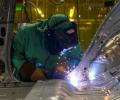
There was a slowdown in the manufacturing sector, which grew at 1.2 per cent in June 2019 as compared to 6.9 per cent a year ago.
India's industrial production growth accelerated to 5 per cent in January 2025, driven by a rebound in manufacturing activity, according to official data released on Wednesday.

Worries about global politics and trade are pulling the Nifty 50 down. Experts say the market could drop further low.

The rupee witnessed a volatile trading session and settled for the day on a slightly lower note, down 1 paisa at 90.66 against the US dollar on Monday, as traders assessed the details of the India-US interim trade framework.

Wholesale price inflation extended upward momentum for the second straight month, recording at 0.83 per cent in December 2025, driven by an uptick in prices of food, non-food articles, and manufactured items on a month-on-month basis, government data showed on Wednesday. Wholesale Price Index (WPI)-based inflation returned to positive in December, after witnessing a deflationary trend in the previous two months.

India's eight key infrastructure sectors' growth jumped to a 13-month high of 6.3 per cent in August 2025 on account of expansion in coal, steel, and cement production, according to official data released on Monday. The core sectors' output growth was 3.7 per cent in the previous month of July.
India's industrial production growth decelerated to a six-month low of 2.9 per cent in February 2025, mainly due to poor performance of the manufacturing, mining and power sectors, according to official data released on Friday. The government also revised upward the industrial growth figure to 5.2 per cent for January 2025 from the provisional estimate of 5 per cent released in March.
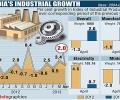
Vivek Mahajan (Head - Research) Aditya Birla Money, analysed the slow IIP growth.
India's industrial production growth remains almost flat at 3 per cent in March sequentially, though, on a year-on-year basis, it slipped from 5.5 per cent, mainly due to poor performance of the manufacturing, mining and power sectors.

Investors would track a host of macroeconomic data announcements scheduled this week, including inflation numbers, and also monitor global market trends, and trading activity of foreign institutional investors, analysts said. The ongoing quarterly earnings announcements and the rupee-dollar trend would also influence the markets.

The output, as measured by the Index of Industrial Production, had contracted by 2.5 per cent in the same month of last year.

The European Union's (EU's) offer to slash tariffs on 97.5 per cent of Indian chemical exports to zero is set to give India's pharmaceutical and medical device firms preferential access to the European markets.

This comes as a shocker for the Indian economy which is going through turbulent times at the moment.
 © 2026 Rediff.com - Advertise with us - Disclaimer - Privacy Policy - Sitemap - Feedback - About us - Terms of use - Grievances